
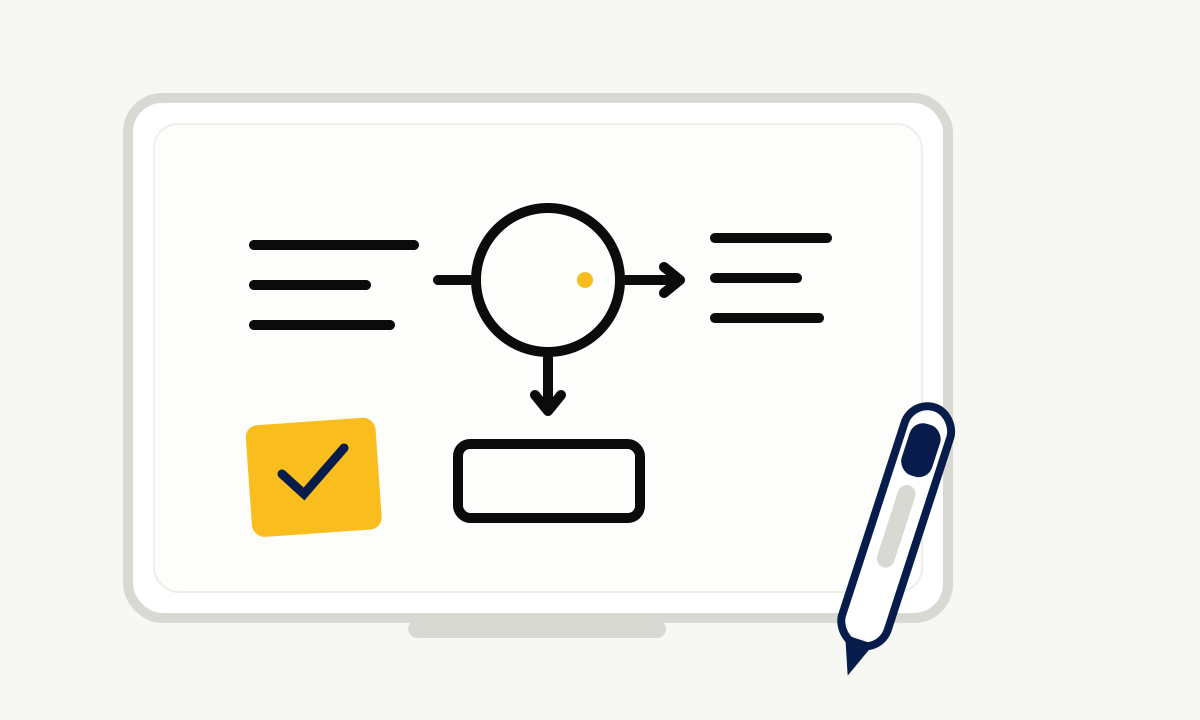
Many useful ideas begin before there is a finished document, presentation, project plan, or final answer. They begin as notes, rough connections, questions, sketches, and pieces of information that need to be arranged. Zekazi is built for that stage of work.
Why we built Zekazi
A lot of digital work starts in a messy way. A student may have lecture notes, questions, diagrams, and a study plan in different places. A founder may have product ideas spread across documents and messages. A professional may need to organize a project before it is ready for a formal plan.
Traditional documents are useful when the structure is already known. A whiteboard is useful earlier, when the structure is still being discovered. We built Zekazi to make that process easier to see and easier to manage.
The goal is not to add another complicated productivity tool. The goal is to create a calm whiteboard where people can place ideas, connect them, reorganize them, and gradually turn them into something clear.
What Zekazi does
Zekazi gives users a flexible whiteboard for ideas, notes, planning, and collaborative work. Instead of forcing every thought into a long document or fixed list, users can organize information spatially and build a structure that makes sense for the task in front of them.
That makes it useful for brainstorming, concept mapping, project planning, research organization, study preparation, early product thinking, and other work where relationships between ideas matter.
AI assistance can support that workflow where it is useful, but the whiteboard remains the center of the experience. The purpose of AI is to help people work with their information more effectively, not to replace the thinking process or make the board harder to understand.
How Zekazi can help students
Students often work with information that is connected but difficult to understand in a straight line. A topic may include definitions, causes, examples, diagrams, questions, and important relationships that become clearer when they are placed next to one another.
A student can use a Zekazi board to break a large subject into smaller parts, connect related concepts, build a revision plan, organize research before writing, or map the steps of an assignment. That can make difficult material easier to review because the structure is visible instead of hidden inside pages of notes.
It can also help students move from collecting information to actually working with it. The board can become a place to ask questions, identify gaps in understanding, compare ideas, and decide what needs more attention before an exam or project deadline.
How it can help professionals
Professional work also starts with unfinished thinking. A project may need to be scoped. A meeting may produce several decisions and follow up tasks. A product idea may need to be broken into users, problems, features, risks, and priorities before anyone starts building.
Zekazi can give that early work one shared whiteboard. A professional can use it to organize a project, prepare a discussion, map a workflow, structure research, or turn an unclear problem into smaller decisions.
The value is not simply having a whiteboard. The value is clarity. A good board can make it easier to see what is connected, what is missing, what is duplicated, and what should happen next.
How it can help teams
Teams lose time when important context is spread across many conversations and tools. A shared board can create one place where people can see the same plan, add ideas, review the structure, and discuss changes around a common reference point.
That can be useful for workshops, planning sessions, product discussions, teaching, research, and small team projects. The objective is not to replace every specialized tool a team already uses. It is to provide a clear board for the thinking that happens before work becomes formal.
Why simplicity matters
Whiteboard products can become complicated very quickly. More menus, more panels, more controls, and more automation can make a flexible board feel heavy. We do not want Zekazi to become difficult just because it is capable.
Our approach is to keep the main experience understandable. A user should be able to open a board and begin working without first learning a complicated system. Features should earn their place by making the work clearer or easier.
This is also why AI should remain understandable. When AI helps with a task, the user should still know what happened, remain in control of the board, and be able to continue working without depending on automation for every step.
Where Zekazi fits inside Zetemora
Zetemora builds three focused products for different kinds of work. Tradeloggy focuses on structured trading review. Zekazi focuses on visual thinking, planning, and collaboration through an AI powered whiteboard. Shidaal Operational System focuses on the operational needs of fuel stations and petroleum businesses.
The products do not need to become copies of one another. Zekazi has a clear job: give people a simple whiteboard where they can think, organize, and move ideas forward.
What we want Zekazi to become
We want Zekazi to remain useful before it becomes large. That means improving the whiteboard experience, making important workflows reliable, keeping the interface clean, and learning which forms of AI assistance genuinely help people instead of adding features simply because they are possible.
The long term opportunity is broader than drawing on a board. A strong AI powered whiteboard can help people understand information, develop ideas, coordinate work, and turn early thinking into practical outcomes.
That is why we built Zekazi. Not to make thinking more complicated, but to give it a clearer place to happen.